
Blinken also underlined that diplomacy is the only way to definitively end the Russian conflict in Ukraine.

Politicians and Twitter warriors around the globe have a new buzzword among them: Net zero. Everyone appears to be keen to state their commitment to net zero, with India providing an outlay of Rs 35,000 crore to achieve energy transition and net-zero objectives in its Budget for FY24, even as the latest and final report by the United Nations' Intergovernmental Panel on Climate Change (IPCC) warned that current efforts are not enough to curb global warming. A number of small factory owners and businesses, however, have pointed out that the transition to net-zero emissions will cost them hugely.

S&P Global Ratings on Thursday said about half of the Indian companies that it rates are getting a boost in their core profitability from rupee depreciation. "Much of our rated India corporate portfolio has sizable US-dollar linked revenue and, therefore, is not exposed to rupee depreciation. "This encompasses entities in the IT, metals, and chemicals sectors. About half of the firms we rate are getting an EBITDA boost from currency weakening," the US-based rating agency said in a report.

'We seem to be in a situation where we can do little, and nothing needs to be done anyway.'

The gap between the highs and the lows in April for the benchmark S&P BSE Sensex was just 4.1 per cent - the narrowest since July 2021 and nearly half its three-year average. The absence of major positive triggers, sectoral rotation, and cautiousness due to earnings and economic uncertainty have kept a tight leash on the markets, observe experts. Remarkably enough, during the 17 trading sessions in April, the Sensex didn't even log an advance or a decline of more than 1 per cent.

He asked to focus on the 'vocal for local' mantra during the 'Azadi ka Amrit Mahotsav' celebrations.

The Centre plans to repeal the existing 80-year old Coffee Act and has proposed a new "Coffee (Promotion and Development Bill), 2022" to promote development of the Indian coffee industry. Through a new law, the government aims to modernise the functioning of the Coffee Board of India that is responsible for boosting production and the quality of Indian coffee, push exports and support the development of the domestic market. The Bill is likely to be introduced in the ongoing session of the Parliament.

Nasdaq-listed information technology (IT) services firm Cognizant will incur the cost of $400 million over two years as it sets to restructure its operations amid sluggish growth rates. Its NextGen Program aims at simplifying the operating model, optimising corporate functions, and consolidating and realigning office space to reflect a post-pandemic hybrid work environment. As part of this structural shift, Cognizant will eliminate 80,000 seats, or 11 million square feet of real estate in large cities in India.

The stock of auto component major Bosch was up 2.5 per cent on Wednesday and in the process hit its 52-week high. Expectations of higher volumes of medium and heavy commercial vehicles' (M&HCV), rise in content supplies on account of BS VI stage 2 implementation from April, and improved profitability are some of the positives for the stock. In addition to this, the company appointed a new managing director and joint managing director last week, which will come into effect from July 1.

George Acland from Great Britain ran a coffee plantation in Sri Lanka and set up India's first jute mill in 1855. He raised capital and imported the machinery for the mill on the banks of the Hooghly in West Bengal. His company wasn't a great success, but his pioneering work paved the way for India to dominate the jute industry.

Indian software and services exports achieved 25 per cent growth during the fiscal year 2002-03, touching a revenue of $9.5 billion.

At a time when Apple delivered its flagship line of new products on schedule despite battling a year of supply-chain turmoil, India could account for at least 12 per cent of the free-on-board (FoB) value of Apple Inc's iPhones manufactured by its vendors globally by 2025-26 (FY26). The number represents a significant shift for the Cupertino-based company's over-dependence on China, where 95 per cent of its phones are still being made. India's growing importance can be seen from the fact that in 2021-22 (FY22) - the first year of the production-linked incentive (PLI) scheme (the scheme was extended by a year due to the pandemic) - the FoB value of iPhones made in the country was $1.75 billion, translating into less than 2 per cent of the global value.

Will open radio access network technology (O-RAN) disrupt the way 5G networks roll out in the country? After all, it promises to offer a substantially lower capital cost, enables the choice of an array of vendors, and provides more network flexibility - all very important for telcos who expect to invest over Rs 60,000 crore to roll out a pan-India 5G network and that's without spectrum costs. But more importantly, it counters the stranglehold of global telecom gear makers such as Ericsson, Nokia, and Samsung over telcos to whom they sell propriety technology and bundled hardware and software.

The further expansion and upgrade of the Chinese military does not augur well for India, which continues to confront an increasingly belligerent China on its borders, notes former foreign secretary Shyam Saran.

Ford, which had announced to quit the Indian market last year, said it was exploring the possibility of using one of its plants in India to produce electric cars for exports.

The Indian economy recovered from the Covid-induced downturn during 2022 and is poised for further improvement in the coming quarters though downside risks emanating from geopolitical tensions, strengthening dollar and elevated inflation will continue. The positive trajectory in the growth trend and improved fundamentals will help the nation in neutralising the impact of global headwinds which are expected to have a bearing on the country's exports in the months to come. The challenges before the government and the Reserve Bank in the new year would be to arrest inflation, check declining value of rupee against US dollar and promote private investment and growth, with a view to ensure that the country remains one the fastest growing major economies of the world.

The US Air Force's (USAF) two newest fifth-generation supersonic multirole F-35A aircraft made a historic debut at Aero-India here on Monday, drawing strong interest and adding lustre to the five-day marquee event.

E-commerce in India could grow to $137 billion by 2020 from $11 billion in 2013, says Morgan Stanley, and firms like Amazon, local market leader Flipkart and rival Snapdeal, backed by Japan's SoftBank, are fighting for a bigger share.
Indian telecom operators have surpassed the three- year 5G network rollout target given to them within six months and now the government is making efforts to enhance adoption of 5G applications across various key segments, a senior government official said in Barcelona. Department of Telecom Additional Secretary VL Kantha Rao told PTI at "India Evening" event on the sidelines of Mobile World Congress 2023 that the government has hosted over 50 companies at the India pavilion and the delegation is here to showcase indigenously-developed 4G and 5G technology stack. "When the spectrum was allocated to telecom service providers for 5G rollout, we gave a minimum rollout obligation saying that within one year they have to cover a few cities within three years, a few towns and so on and so forth.

How dominant are Chinese firms in India's sub-Rs 10,000 mobile device market? The question has become relevant as the government has been thinking of reserving this price segment for domestic players who have not been able to battle the Chinese onslaught. However, telecom firms and others are concerned that such a move could stymie the effort to build affordable 5G phones in the sub-Rs 10,000 category.

According to the experts, a lot of countries have little or no faith in Chinese companies because of poor after-sales support and equipment that rapidly declines into non-functional machinery.

5G networks in India can be deployed in three months but in limited areas as the optical fibre based infrastructure to support the technology is not ready yet, telecom industry players said on Tuesday. Nokia India head of marketing and corporate affairs Amit Marwah said that India has to take a call on deployment of 5G services otherwise it will miss to take advantage of the next generation technology that it can bring for the economy.

The government is considering the option of inviting fresh applications to bid for the fourth slot which fell vacant after one of the initial candidates who qualified, Hyundai Global Motors, exited from the production-linked incentive (PLI) scheme for advanced chemistry cell battery storage with a capacity of 20 GwH. Earlier, stakeholders had expected that the vacant slot would be offered to waitlisted players ranked on their technical and financial offer. A final decision will be taken soon.

In a tribute, President Joe Biden called him a "born patriot", while Indian External Affairs Minister S Jaishankar hailed him as a thought-provoking global strategist.

Apple's newest phone iPhone 14 will be made in India as the global tech titan bets big on the manufacturing prowess of the world's second-biggest smartphone market after China.

Even as India strives to climb the development mountain, the fact is that the mountaintop is already crowded. If it got there in 2047, India would be very much a late-comer, observes T N Ninan.

Asserting that Indian democracy is a "global public good", Congress leader Rahul Gandhi has said that its "collapse" will have an impact on the world and is not in America's national interest.

Prime Minister Narendra Modi on Saturday inaugurated the 6th India Mobile Congress at Pragati Maidan in Delhi and launched 5G services. The 5G telecom services seek to provide seamless coverage, high data rate, low latency and highly reliable communications system. The three major telecom operators of the country demonstrated one use case each in front of the prime minister to show the potential of 5G technology in India.

After helping the government in policymaking since October 2014, Chief Economic Adviser Arvind Subramanian is returning to academics and will be teaching at Harvard Kennedy School on a visiting position. In an interview to Dilasha Seth and Somesh Jha, he says the ease of doing business agenda needs to move forward and India must try to integrate with the global value chains. Edited excerpts.

Prime Minister Modi will embark on his first state visit to the United States at the invitation of President Joe Biden and First Lady Jill Biden in June.

Reliance Industries Ltd, whose offering of rock-bottom tariffs shook up the telecom industry, is looking to repeat the feat in the green energy business, where its billionaire chairman Mukesh Ambani sees promise to outshine all existing growth engines in 5-7 years. Having pledged Rs 6 lakh crore on green energy, Ambani says RIL will scale up investments in this business which will start going live in the next 12 months. "Over the next 12 months our investments across the Green Energy value chain will gradually start going live, scaling up over the next couple of years," Ambani, chairman and managing director of RIL, said in the company's latest annual report.

The information technology services sector will see a sharp fall in revenue growth to 12-13 per cent in FY23 from 19 per cent in FY22, ratings agency Crisil said on Thursday. However, the current depreciation in the rupee, strong demand for new age technologies like artificial intelligence, cloud computing and Internet of Things will help the over $220-billion sector maintain a double digit growth, it said in a report. The moderation from 19 per cent to 12-13 per cent will be the highest in the last eight years, it said and attributed the decline to expected tightening of IT expenditure by corporates amid the inflationary headwinds in the United States and European Union (EU), which together contribute almost 85 per cent to the sector's revenue.

No longer a discretion of the tax administrator, the audit of returns filed by taxpayers is now based on a selection by algorithms, notes Tarun Bajaj.

Due to the huge pile-up of visa applications, the US consular officers in the neighbouring country are now adjudicating Indian visa applications where interview requirements have been waived.

'We will celebrate Independence Day as usual, but not this celebration from August 15 to 22 (as sought by the Modi government).'

Just a few weeks ago, Communications Minister Ashwini Vaishnaw did some tough talking with the senior managers of Bharat Sanchar Nigam Ltd, the ailing state-owned telecom service provider. The message was clear: They had to perform, quit by taking the voluntary retirement package or be compulsorily retired from service. The terse message from an otherwise polite and soft-spoken minister came just days after he announced a second and bigger package of Rs 1.64 trillion as part of a four-year turnaround plan for BSNL.

Mukesh Ambani, who took over the reins of Reliance Industries Ltd (RIL) after the sudden demise of his legendary industrialist father Dhirubhai Ambani, completes 20 years at the helm during which the company saw a 17-fold jump in revenues, 20-times surge in profit and has become a global conglomerate.

After a turnaround in performance by Indian equity markets since July that has seen the S&P BSE Sensex and the Nifty50 wipe out the year-to-date losses, analysts suggest investors start nibbling into stocks that are focused on the domestic economy. While they say intermittent corrections, led by policies of global central banks and other economic data, cannot be ruled out, analysts expect India's relative outperformance among global equity markets to continue as it looks better placed with a healthy economic recovery, and remains one of the fastest growing major economies. In this backdrop, Neeraj Chadawar, head of quantitative equity strategy at Axis Securities, believes that amid global slowdown, aggressive tightening by the central banks, and preference for domestic interests first (by the local government), export-oriented themes are likely to be muted or will deliver conservative returns in the near-term.

New Delhi is vulnerable to US sanctions under a 2017 law called CAATSA.
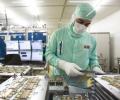
Mumbai-based Indian Semiconductor Manufacturing Company (ISMC) and Singapore-headquartered IGSS Ventures have one strategy in common: They have told the government in their application for semiconductor fabrication plants that they will export the bulk of the chips they make in India in the initial five or 10 years. The third applicant, Vedanta-Foxconn, which is also building a fab plant, has said it will concentrate on the needs of consumer electronics and mobile device markets, and earmark 80 per cent of output for domestic consumption, but has not specified its customers. Finding a viable domestic market could well be the biggest challenge for India's renewed tryst with semiconductors. Fab plants do not sell directly to end users but to intermediary chip design companies - such as Qualcomm or MediaTek.
